
Root Canal Therapy in Hutto, TX
A root canal treats damaged or infected tissue inside a tooth to help relieve pain and save the tooth. With the area numbed, most patients find treatment feels similar to getting a filling.
Questions? (512) 806-7740 Call Text
Clinically reviewed by Han Nguyen, DDS Last reviewed
At Hutto Hippo Family Dental, Dr. Han Nguyen takes a gentle, step-by-step approach and makes sure you’re numb and comfortable before treatment begins. We see patients from Hutto and nearby Taylor, Round Rock, Pflugerville, and Georgetown.
When Is a Root Canal Needed?
You may need a root canal if you have:
- Severe tooth pain when chewing or applying pressure
- Prolonged sensitivity to heat or cold
- Darkening or discoloration of the tooth
- Swelling or tenderness in nearby gums
- A persistent pimple or abscess on the gums
If left untreated, an infected tooth can lead to abscesses, bone loss, and infection spreading to other parts of the body.
Sometimes an infected tooth causes no pain at all and the problem shows up first on an X-ray at a routine checkup. And tooth pain that suddenly stops isn’t always good news: it can mean the nerve inside the tooth has died while the infection remains. If you have swelling in your face or jaw or a fever, call or text us right away at (512) 806-7740. If swelling makes it hard to breathe or swallow, or spreads toward your eye or neck, go to the nearest emergency room or call 911. See emergency dental care for more.
The Root Canal Process
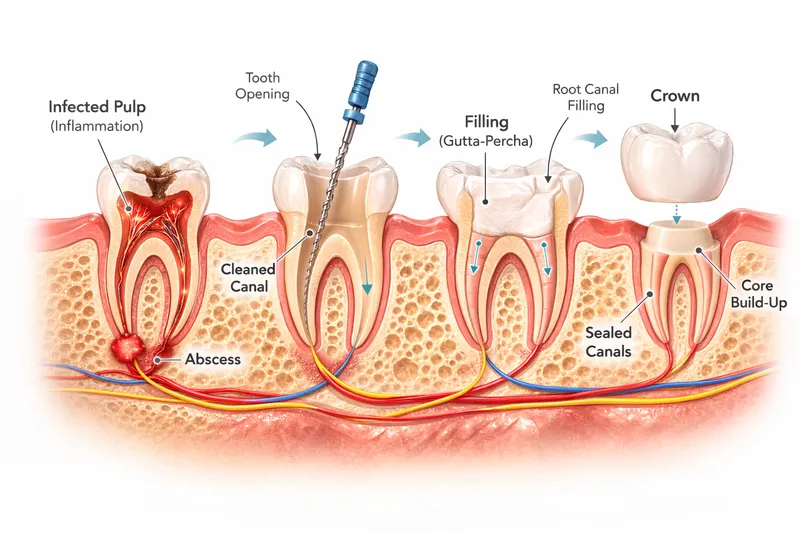
- Diagnosis – We take X-rays to confirm the infection and plan treatment
- Anesthesia – The area is numbed so you feel little to no discomfort
- Access – A small opening is made in the crown of the tooth
- Cleaning – The infected pulp is removed, and the canals are cleaned and shaped
- Sealing – The canals are filled with a biocompatible material called gutta-percha
- Restoration – A crown is typically placed to protect and restore the tooth
What to Expect on Treatment Day
You’ll be awake and numb, much like a filling visit. We place a small rubber sheet (a dental dam) around the tooth to keep it clean and dry, so you can breathe and swallow normally while we work. Most patients rest comfortably through the procedure. If you feel anxious about dental work, ask about nitrous oxide to help you relax.
Save Your Natural Tooth
Root canal therapy allows you to keep your natural tooth, which is almost always preferable to extraction. Natural teeth are better for chewing efficiency, jawbone health, and overall oral health. Tooth loss can lead to jawbone shrinkage, shifting of adjacent teeth, and changes in facial structure over time.
Root Canal or Extraction?
| Feature | Root canal + crown | Extraction |
|---|---|---|
| Keeps your natural tooth | Yes | No |
| Next step | A crown to protect the tooth | Replacing the tooth with an implant, bridge, or partial denture is usually recommended |
| Effect on nearby teeth | Usually none; the tooth keeps its place in your bite | Neighboring teeth can drift into the gap if it isn’t replaced |
An extraction can cost less on the day, but replacing the missing tooth afterward can cost more than saving it. Some teeth are too broken down or cracked to save. If that’s the case, we’ll explain why and talk through your replacement options.
Recovery After a Root Canal
Most patients feel significantly better within a day or two of the procedure. The tooth and surrounding area may be tender for a few days, which is normal. You can manage discomfort with over-the-counter pain relievers such as ibuprofen. Avoid chewing hard foods on the treated tooth until the crown is placed.
For back teeth, the crown placed after root canal therapy is crucial. Decay, old fillings, and the small opening made during treatment remove some of the tooth’s structure, which leaves it weaker, and back teeth take heavy chewing forces. A crown covers and protects it from fracturing. Without one, a root canal-treated tooth is vulnerable and may crack, sometimes badly enough that it can’t be saved.
A Typical Recovery
- First day: Numbness wears off within a few hours. Eat soft foods and chew on the other side.
- First few days: The tooth may feel tender when you bite. Over-the-counter pain relievers usually control it, and most people go back to work or school the next day.
- Until your crown is placed: Your tooth has a temporary filling. Avoid hard or sticky foods on that side.
- Call us if pain gets worse instead of better after a few days, swelling returns, or your bite feels uneven.
Cost and Insurance
The cost of a root canal depends mainly on which tooth is treated. Front teeth usually have one canal, while molars have three or more, so molars take longer and cost more. Most teeth also need a crown afterward, which is a separate fee.
Many dental plans cover part of the cost of root canal therapy. We accept and file most dental insurance plans. We can’t accept HMO or Medicaid plans, and we’re out-of-network with Delta Dental (you pay at the visit, and Delta usually reimburses you). Before treatment we’ll check your benefits and give you a written estimate. It’s our best estimate of what your plan will pay, not a guarantee. We also offer flexible payment plans and an in-house dental plan. See our insurance and payment FAQs for details.
Common Questions About Root Canals
Does a root canal hurt? We numb the area before treatment. You may feel pressure, but tell us if anything hurts so we can help. Most patients say it feels similar to having a filling placed.
How long does a root canal take? Most root canals can be completed in one or two appointments, each lasting about 60–90 minutes.
Will I need to see a specialist? Most root canals can be done here. Some teeth have curved, narrow, or hard-to-find canals, or need an old root canal redone. In those cases, we may refer you to a root canal specialist (endodontist) and explain why.
Will I need a crown after a root canal? Usually, yes, especially for back teeth. A crown protects the treated tooth from cracking. Some front teeth that are otherwise healthy can be restored with a filling instead; we’ll let you know which applies to you.
Can I go back to work after a root canal? Most people return to work or school the same day or the next day. You may want to wait until the numbness wears off before eating.
Will antibiotics fix a tooth infection? No. Antibiotics can help control swelling or a spreading infection, but they can’t reach the infected tissue inside the tooth. The tooth still needs a root canal or extraction to remove the source of the infection.
How long does a root-canal-treated tooth last? With a crown, good home care, and regular checkups, a tooth that has had a root canal can last for many years.
Can I drive myself home after a root canal? Yes — unless you have chosen sedation dentistry, you will be fully alert and able to drive yourself home.
What happens if I don’t get a root canal? An untreated infected tooth will not heal on its own. The infection can spread to the jaw, neck, and head, and in rare cases can become life-threatening. Antibiotics may temporarily relieve symptoms but cannot cure the infection.
Related Services
Root canals work hand-in-hand with other restorative care:
- Dental Bridges & Crowns — a crown is typically placed after root canal therapy to protect the tooth
- Sedation Dentistry — if dental anxiety is a concern, nitrous oxide is available for your comfort
- Emergency Dental Care — severe tooth pain or an abscess needs prompt care; call or text and we’ll do our best to see you the same day
Don’t let fear keep you from getting the care you need. Contact us today to schedule a consultation.
Ready for a healthier smile?
Schedule your appointment today. We accept and file most dental insurance plans and offer flexible payment options. New patients are always welcome!